
Skip to content ↓

Special Education Needs and Disability - SEND
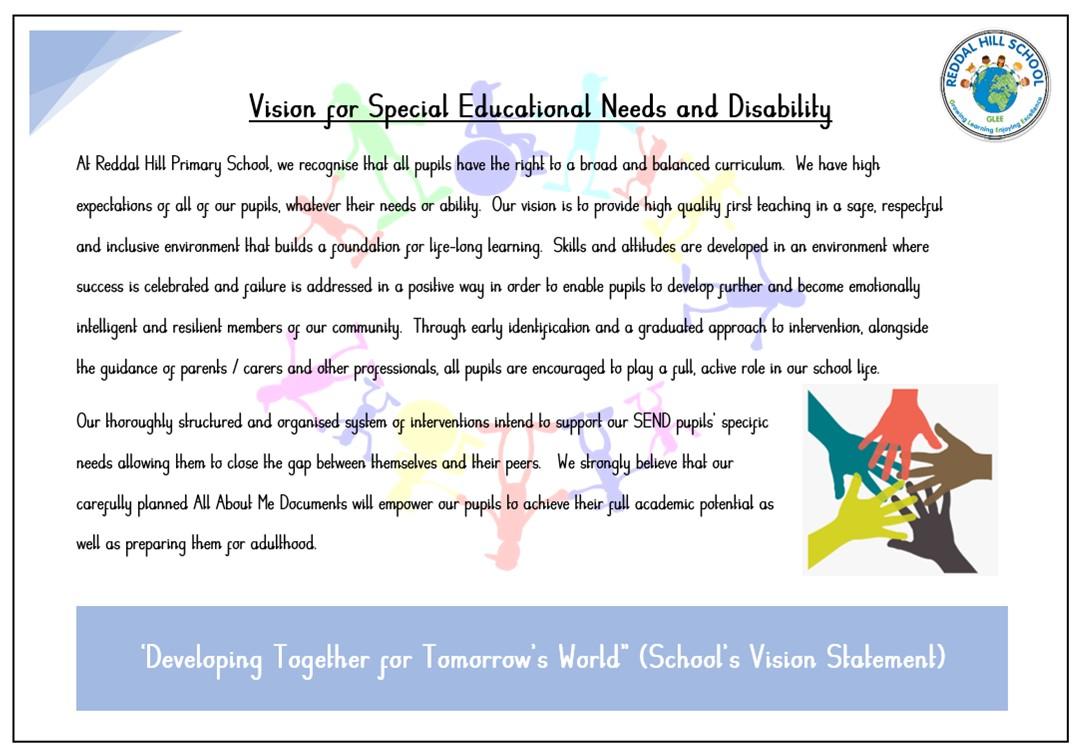
Special Educational Needs

A child or young person has a Special Educational Need and/or Disability if they have a learning difficulty or disability which calls for special educational provision to be made for him/her. 

According to the SEND Code of Practice (2015, p.16) a child or young person has a learning difficulty if they have:

  • a significantly greater difficulty in learning than the majority of others of the same age, or
  • has a disability which prevents or hinders him or her from making use of facilities of a kind generally provided for others of the same age in mainstream schools

SEND Information Report and Policy

  • See documents below.

Areas of Need

Communication and Interaction

Children and young people with Speech, Language and Communication Needs (SLCN) may experience difficulties understanding and using language to communicate effectively. This can affect their ability to express their thoughts, feelings and needs, follow instructions, engage in conversations and access learning. Some pupils may also find it challenging to understand and use the social aspects of communication, such as taking turns in conversation, interpreting body language and facial expressions, or developing and maintaining relationships. For example, pupils with Autism Spectrum Disorder (ASD) may experience differences in social communication and interaction.

Other pupils may have Developmental Language Disorder (DLD), which affects their ability to understand and use spoken language, impacting learning, social interactions and emotional wellbeing. Some pupils may also experience speech sound or articulation difficulties, making it harder for them to pronounce sounds and words clearly, which can affect their confidence and ability to communicate effectively with others.

Through a supportive and inclusive environment, alongside targeted interventions, visual support and communication-friendly teaching strategies, we help pupils develop their communication skills, build positive relationships, increase their confidence and participate successfully in all aspects of school life.


Cognition and Learning Needs

Children and young people with Cognition and Learning Needs may learn at a different pace from their peers and require additional support to access the curriculum, develop key skills and achieve their full potential. They may experience difficulties with areas such as attention, processing information, memory, problem-solving, literacy, numeracy, organisation and independent learning.

Some pupils may have identified learning difficulties, including:

  • Moderate Learning Difficulties (MLD)
  • Severe Learning Difficulties (SLD)
  • Profound and Multiple Learning Difficulties (PMLD)
  • Specific Learning Difficulties (SpLD), such as dyslexia, dyspraxia (Developmental Coordination Disorder) and dyscalculia

Through high-quality adaptive teaching, targeted interventions and appropriate support, we aim to remove barriers to learning and ensure that all pupils can access an ambitious curriculum, make meaningful progress and develop confidence, independence and resilience. We work closely with families and external professionals to identify needs early and provide personalised support that enables every child to participate fully in school life and achieve the best possible outcomes.


Social, Emotional and Mental Health (SEMH) Needs

Children and young people with Social, Emotional and Mental Health (SEMH) needs may experience a wide range of difficulties that can impact their wellbeing, relationships, behaviour and engagement with learning. Some pupils may appear withdrawn, anxious or isolated, while others may find it challenging to regulate their emotions, manage their behaviour or develop positive relationships with peers and adults.

SEMH needs can present in different ways and may include experiences of anxiety, low mood, emotional dysregulation, trauma, attachment difficulties or low self-esteem. Some pupils may also have diagnosed conditions such as Attention Deficit Disorder (ADD), Attention Deficit Hyperactivity Disorder (ADHD) or Attachment Disorder, which can affect their ability to focus, self-regulate and engage successfully in school life.

At our school, we are committed to creating a safe, nurturing and inclusive environment where all pupils feel valued, understood and supported. Through strong relationships, consistent routines, adaptive teaching approaches, pastoral support and targeted interventions, we help pupils develop emotional literacy, resilience, self-confidence and positive coping strategies. We work closely with families and external professionals to ensure that every child receives the support they need to thrive both academically and socially.


Sensory and/or Physical Needs

Children and young people with Sensory and/or Physical Needs may require additional support to access learning, participate fully in school life and achieve their full potential. These needs can include:

  • Visual Impairment (VI)
  • Hearing Impairment (HI)
  • Physical Disability (PD)
  • Multi-Sensory Impairment (MSI)

Pupils with sensory or physical needs may experience barriers to learning, communication, mobility or independence and may benefit from specialist equipment, adapted resources, environmental adjustments or targeted support. Some pupils may also require ongoing input from specialist services, such as teachers of the visually impaired or hearing impaired, physiotherapists, occupational therapists or other healthcare professionals.

At our school, we are committed to creating an inclusive, accessible and supportive environment where all pupils can participate fully in learning and wider school life. Through reasonable adjustments, adaptive teaching, specialist resources and continuous improvements to accessibility, we strive to remove barriers and ensure every child can thrive, develop independence and achieve the best possible outcomes.

SEND Provision Statement

Our specialist provision (The NEST) is designed to support pupils who are currently enrolled in our school and have been identified as benefiting from additional targeted support within our existing setting.  It is not a designated placement for pupils with an Education, Health and Care Plan (EHCP) seeking specialist provision through the Local Authority.  

Requests for specialist placements for children not currently attending our school should be made through the appropriate Local Authority admissions and SEND placement process. 

Please note that our specialist provision is funded by the school and not the Local Authority.  As such, places are limited to pupils already attending our school who meet the criteria for internal support. The provision is currently at full capacity, and we are unable to accept any additional pupils at this time. 

Agency Support

Local Offers

Parental Concerns

At Reddal Hill Primary School, we recognise the importance of effective partnerships with our parents/carers in meeting the individual needs of our children.  If you have any concerns regarding your child's learning or feel that they are having difficulties at school, please discuss these concerns with your child's class teacher or Mrs. K. Beard, Assistant Headteacher of Inclusion, by completing the form below.

SEND Information Form

If you have any questions or comments regarding your child's Special Educational Needs or wish to speak to Mrs Beard, please complete the form below.


Useful Websites

General 

Action For Children | Children's charity | For safe and happy childhoods

Sandwell Local Offer | Family Information Service Hub

Learning Disability - Down's Syndrome - Williams syndrome | Mencap

ADHD

Let's talk about ADHD - YouTube

Autism

Autism West Midlands | Supporting the Autistic Community

National Autistic Society (autism.org.uk)

Cerebral Palsy

Cerebral Palsy

Action Cerebral Palsy (actioncp.org)

Cerebral palsy - NHS (www.nhs.uk)

Down Syndrome 

Learning Disability - Down's Syndrome - Williams syndrome | Mencap

Home - Downs Syndrome Association (downs-syndrome.org.uk)

Dyslexia 

British Dyslexia Association (bdadyslexia.org.uk)

Dyspraxia

Dyspraxia at a glance – Dyspraxia Foundation

Family Support Services 

Family Services, Support and Help | Sandwell Family Hubs

Family Information Service Hub (sandwell.gov.uk)

General 

Action For Children | Children's charity | For safe and happy childhoods

Sandwell Local Offer | Family Information Service Hub

Learning Disability - Down's Syndrome - Williams syndrome | Mencap

Hypermobility  

The HMSA | The Hypermobility Syndromes Association

Physical Disability / Sensory (Hearing, Vision, Sight)

National Deaf Children's Society | Supporting deaf children (ndcs.org.uk)

Welcome to the Royal Society for Blind Children (rsbc.org.uk)

Sensory

Sense – Interoception – Sensory Processing (humber.nhs.uk)

The Sensory Coach - YouTube  

Social, Emotional Mental Health

Guide to CAMHS | Children and Adolescent Mental Health Services | YoungMinds

Speech and Language 

British Sign Language - Online resources, games, & course. (british-sign.co.uk)

Speech and Language UK: Changing young lives

Home (makaton.org)