
Writing
Writing - Jane Considine Approach
Implementation
At Reddal Hill we have adopted 'The Write Stuff' by Jane Considine, to bring clarity and consistency to the mechanics of writing and to enable our children to write effectively and coherently. As a school, all children from Year 1 to Year 6 learn to write through the Write Stuff approach. This was developed by teacher and leading English consultant, Jane Considine. It is a fun, creative and rigorous approach to develop children's writing. This approach allows children to apply basic skills, vocabulary and grammar knowledge to write effective sentences that have real impact and keep the reader interested.
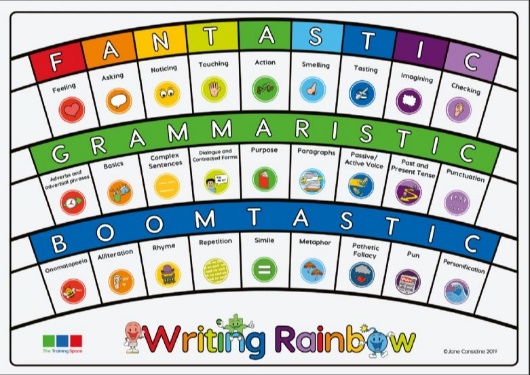
In The Write Stuff approach to writing, children explore high quality, rich vocabulary and are taught grammar in context through different writing lenses on the Writing Rainbow. There are three lenses used to support children with their writing:
Fantastics – ideas for writing
Grammaristics – tools for writing
Boomtastics – writing techniques.
The Write Stuff is based on two guiding principles; teaching sequences that slide between experience days and sentence stacking lessons.
As part of the teaching sequence, teachers plan experience days, sentence stacking lessons and independent writing sequences.
Experience days immerse children in experiences linked to their writing and drench them in vocabulary linked to the lenses in ‘The Writing Rainbow’. From the experience days, children take part in the sentence stacking lessons. Sentence stacking lessons focus on writing three sentences that focus on the lenses from the rainbow.
‘The Write Stuff’ follows a method called ‘Sentence Stacking’ which refers to the fact that sentences are stacked together and organised to engage children with short, intense moments of learning they can that immediately apply to their writing.
Structure of a Sentence-Stacking Lesson
An individual lesson is based on one plot point from the text, broken into three learning chunks:
- Initiate section – a stimulus to capture the children’s imagination and set up a sentence.
- Model section – the teacher models a sentence that outlines clear writing features and techniques.
- Enable section – the children write their sentence, following the teacher’s model.
This part of the unit is heavily scaffolded with consistent teacher input, modelling of vocabulary, sentence construction and the use of grammar with reference to the 3 writing lenses.
During the initiate section, children ‘chot’ (chat and jot) down their ideas from stimulating resources, such as pictures, music and drama. The children are encouraged to use ‘kind calling out’ where they share examples of vocabulary, adverbs, onomatopoeia etc.
During the model section, the teacher prepares children for writing by modelling the ideas, grammar and techniques of writing drawn from the writing rainbow.
In the enable section, children write their own sentences, taking the opportunity to deepen the moment. ‘Deepen the Moment’ is where children are challenged to independently draw upon previously learnt skills and apply them to their writing during that chunk.
Independent Writing and Short Burst Writing
Following sentence stacking, pupils plan and produce an independent piece of writing. After completing this, they independently edit their work using a purple polishing pen.
Teachers then analyse the writing and select a paragraph to refine as a class through short‑burst writing sessions, focusing on sentence‑level improvement. These sessions may include:
- Sentence combining – joining shorter sentences to improve structure and flow
- Sentence shrinking – condensing information for clarity and pace
- Sentence expanding – adding detail or literary features
- Sentence signposting – exploring the use of conjunctions and their impact
Teachers also identify further areas for development, such as punctuation, spelling or grammar, which are addressed through daily starters.
At the end of the short‑burst sequence, pupils write a new paragraph demonstrating their improved sentence‑level control and application of skills. This is then marked by the teacher to identify progress against the writing skill ladder assessment criteria.
Approach to Editing
We have recently refined our approach to editing, in line with our newly implemented short‑burst writing model. As teachers analyse writing and plan responsively, the editing process is now continually taught and modelled through daily starters and sentence‑level lessons. The Jane Considine editing codes are therefore not currently being used.
Once the short‑burst writing model is fully embedded, we aim to reintroduce and formally teach editing as part of the planning and writing process from September 2026, ensuring it is fully integrated rather than taught in isolation.
Impact
Having followed the Write Stuff approach, children should be able to:
- Write for a range of purposes including diary entries, persuasive letters, stories, poems and recounts to name but a few.
- Use their vast knowledge to excite, inform and entertain the reader.
- Understand a range of punctuation and the effect it can have on the reader in both reading and writing.
- Understand and be able to use a range of grammatical devices.
- Understand the various sentence types that can be used to support different genres.
- Spell accurately using their phonetic knowledge and apply spelling rules
To speak clearly, fluently and coherently, to be able to listen attentively with understanding, pleasure and empathy and contribute to group discussion.